
Table of Contents
Introduction
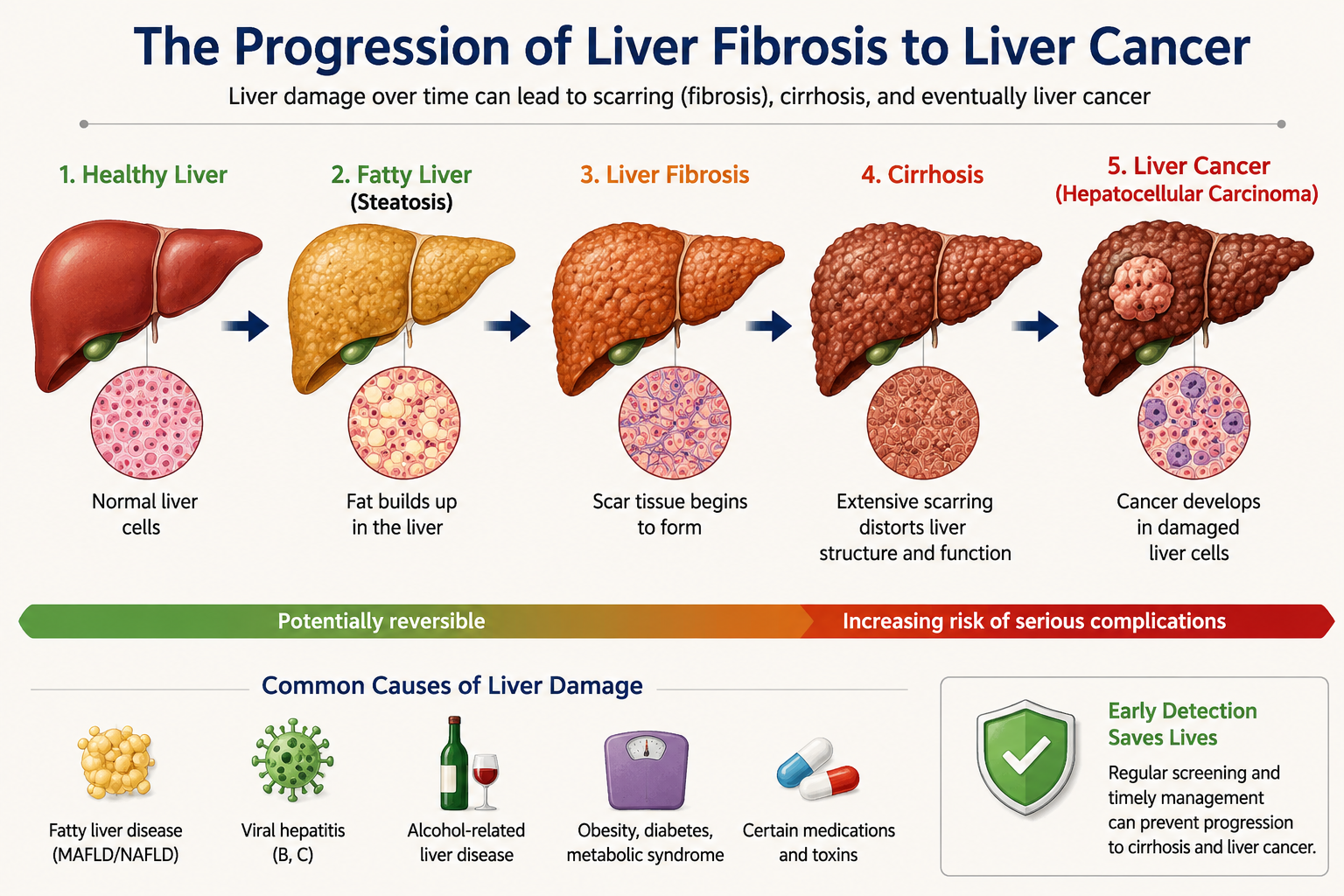
Liver fibrosis is the gradual formation of scar tissue in the liver that occurs when the organ repeatedly tries to repair itself after ongoing injury. It can develop due to conditions such as Fatty liver disease, viral hepatitis, alcohol-related liver disease, and other chronic liver disorders. Because liver fibrosis usually causes no symptoms in its early stages, many people remain unaware of the condition until significant liver damage has already occurred. Detecting fibrosis early is important because timely intervention can slow or even prevent progression to cirrhosis, liver failure, or liver cancer.
Chronic liver disease is a major global health problem, affecting more than 1.3 billion people worldwide and causing over 2 million deaths each year. Identifying people with advanced liver fibrosis at an early stage is therefore an important part of routine clinical care, especially in those with metabolic risk factors or chronic liver disease.
Although a liver biopsy remains the gold standard for diagnosing liver fibrosis, it is an invasive procedure that can be expensive and carries risks such as pain and bleeding. It may also miss affected areas of the liver, and interpretation can vary between pathologists. Because repeated biopsies are not practical, several non-invasive tests have been developed. Among them, the Fibrosis-4 (FIB-4) Index is one of the simplest and most widely used tools for estimating the risk of advanced liver fibrosis using routine blood test results.
In this blog, you’ll learn what the FIB-4 Index is, how it is calculated, who should get it, and how to interpret the results.
What Is the FIB-4 Index?
- A simple, non-invasive tool that helps estimate the risk of advanced liver fibrosis (scarring).
- It is calculated using four routine clinical parameters.
- Doctors commonly use this as a first-step screening test for people with fatty liver disease and other chronic liver diseases.
Who May Benefit from a FIB-4 Index?
- FIB-4 index is recommended for people who are at higher risk of advanced liver fibrosis, including those with:
- Type 2 diabetes
- Two or more metabolic risk factors, such as:
- Obesity or overweight
- High blood pressure
- High cholesterol or triglycerides
- Prediabetes
- Fatty liver detected on an ultrasound or other imaging test
- Persistently elevated liver enzymes
How is the FIB-4 Index Calculated?
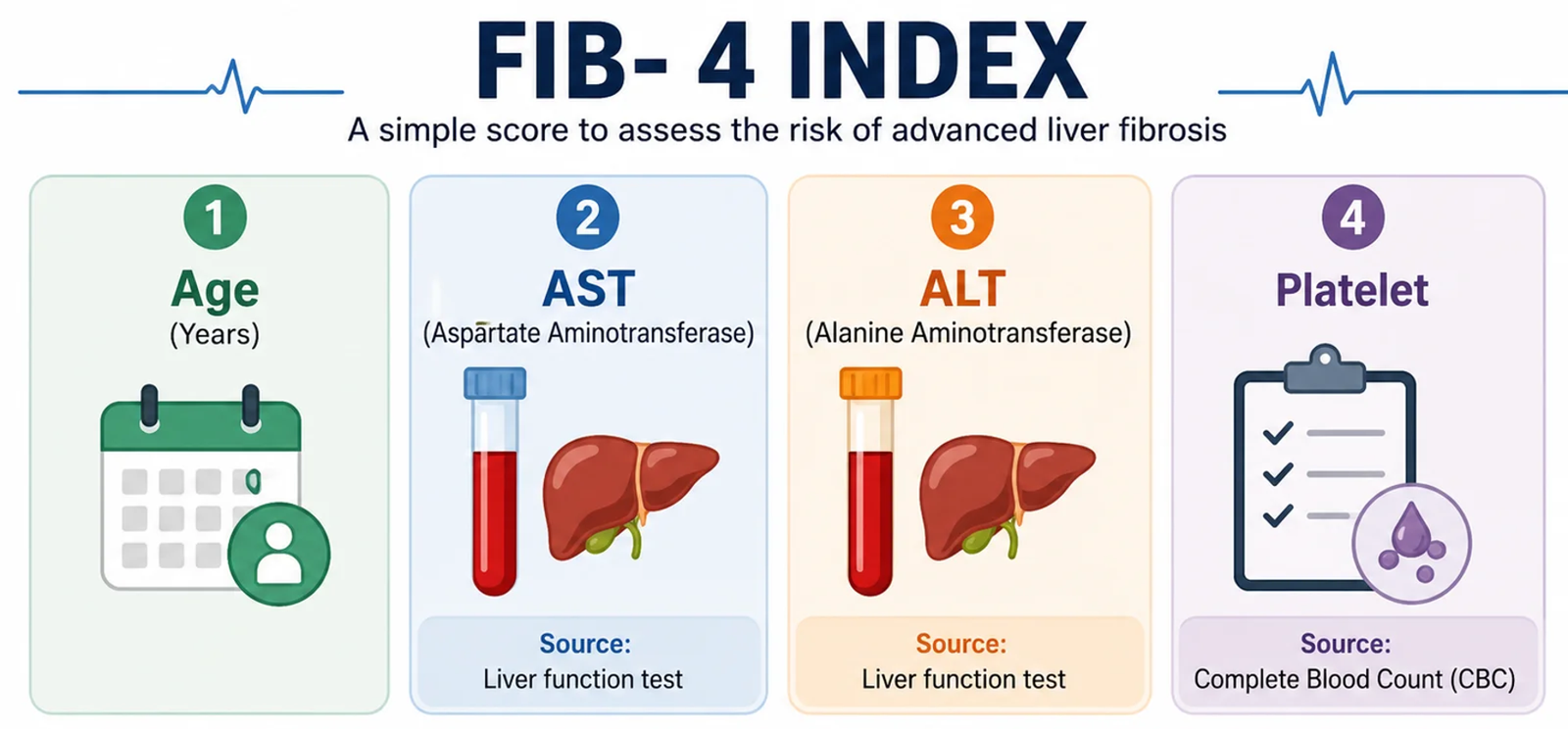
following information is needed to calculate the FIB-4 Index
1. 📅 Age (Years)
2. 🧪 AST (Aspartate Aminotransferase) – Source: Liver function test
3. 🧪 ALT (Alanine Aminotransferase) – Source: Liver function test
4. 📋 Platelet count – Source: Complete Blood Count (CBC)
These four values are entered into the FIB-4 formula to calculate the FIB-4 Index, which helps estimate the risk of advanced liver fibrosis.
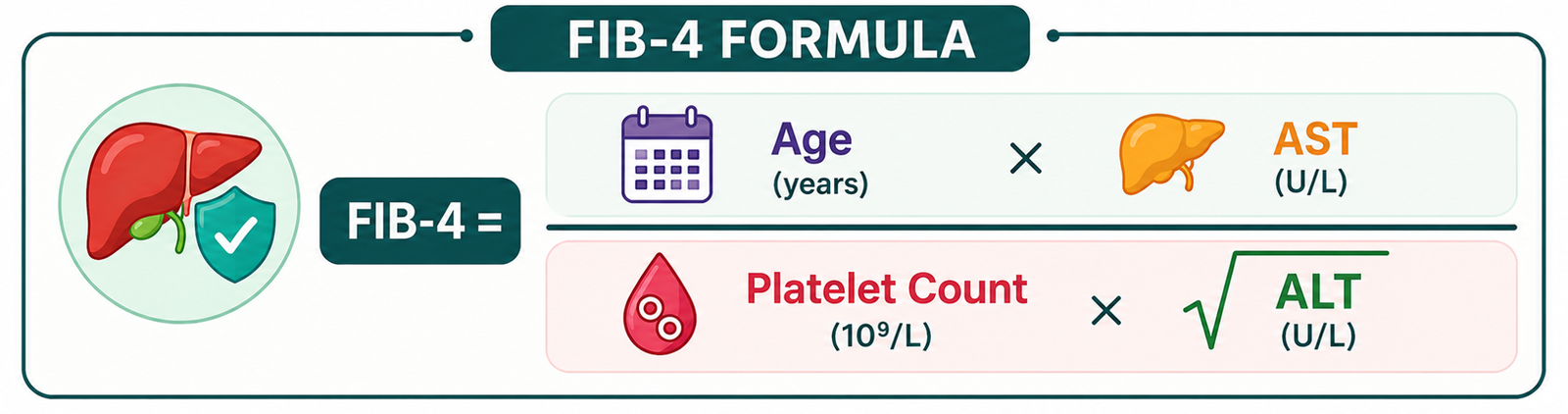
You don’t need to calculate this manually. Online calculators automatically compute the FIB-4 Index once these values are entered.
How Do You Interpret Results?
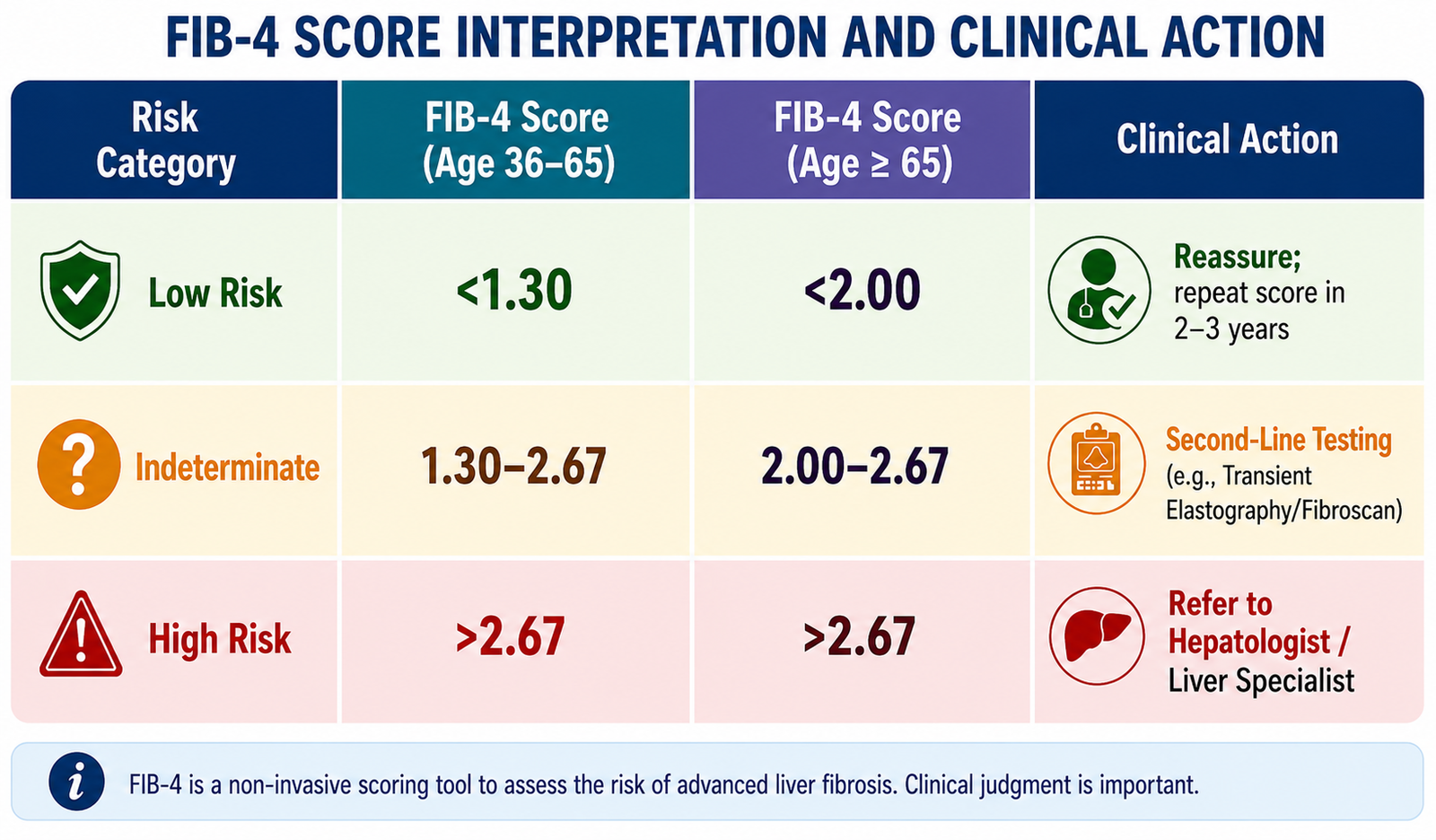
- The FIB-4 Index helps estimate the likelihood of advanced liver fibrosis using your age, AST, ALT, and platelet count.
- The interpretation depends on your age, as different cut-off values are used for adults aged 36–65 years and those aged 65 years or older.
- Based on your FIB-4 Index, your risk falls into one of three categories: low risk, indeterminate, or high risk, which helps guide the next clinical steps.
What Happens If Your FIB-4 Score Is High?
- A high FIB-4 score suggests that you may be at an increased risk of advanced liver fibrosis, but it does not confirm the diagnosis.
- Additional evaluation is usually needed. Your healthcare provider may recommend:
- Transient elastography (FibroScan) or another non-invasive test to assess liver stiffness.
- Blood tests or imaging studies to look for the underlying cause of liver disease.
- Referral to a hepatologist (liver specialist) for further evaluation, if needed.
If advanced fibrosis is confirmed, early treatment and regular follow-up can help slow disease progression and reduce the risk of complications. Always discuss your FIB-4 results with your healthcare provider, who will interpret them in the context of your overall health and medical history.
When Is the FIB-4 Index Not Recommended?
The FIB-4 Index may be less accurate or not recommended in the following situations:
- People younger than 35 years, as its accuracy is lower in this age group.
- People with acute hepatitis or sudden liver injury, where liver enzyme levels (AST and ALT) may be temporarily elevated.
- People with conditions that affect platelet counts, such as certain blood disorders, may have a higher score.
- People receiving chemotherapy or medications that significantly alter liver enzyme or platelet levels.
- People with known cirrhosis, as the FIB-4 Index is designed to estimate the risk of advanced fibrosis, not to assess established cirrhosis.
What Are the Limitations of the FIB-4 Index?
- ⚠️ Less accurate in people under 35 or over 65 years
- 🧪 Blood test results can affect the score
- 🍷 Alcohol use may falsely increase the score
- 🩸 Low platelet counts from other causes can cause false positives
- 🔍 A screening tool, not a diagnosis; further tests may be needed
Key Takeaways
- ✅ Non-invasive – No liver biopsy needed
- ✅ Low cost – Uses routine blood tests
- ✅ Easy to calculate – Takes only minutes
- ✅ Widely recommended – Included in international liver guidelines
- ✅ Helps prioritize patients – Identifies those needing specialist evaluation
Conclusion
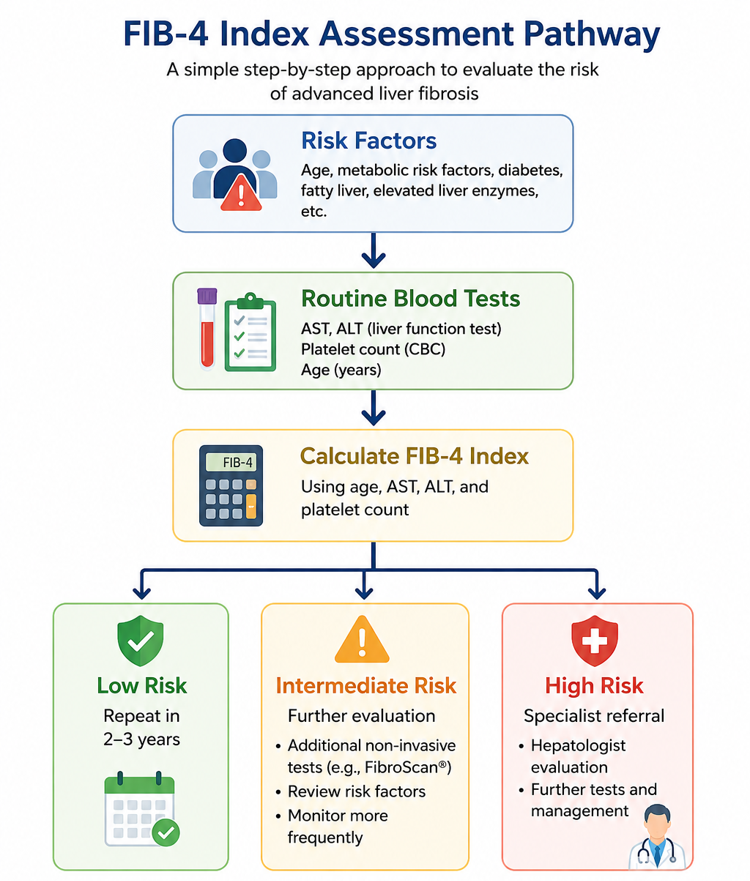
The FIB-4 Index is a simple, inexpensive, and widely recommended screening tool for identifying people at risk of advanced liver fibrosis. Although it cannot diagnose liver disease on its own, it helps determine who may benefit from additional tests such as FibroScan or referral to a liver specialist. If you have fatty liver disease, diabetes, or other metabolic risk factors, discuss your FIB-4 score with your healthcare provider as part of your liver health assessment.
Further Reading
- Anstee, Q. M., Berentzen, T. L., Nitze, L. M., Jara, M., Jensen, A. B., Kjær, M. S., Mangla, K. K., Tarp, J. M., & Khunti, K. (2024). Prognostic utility of Fibrosis-4 Index for risk of subsequent liver and cardiovascular events, and all-cause mortality in individuals with obesity and/or type 2 diabetes: A longitudinal cohort study. The Lancet Regional Health – Europe, 36, Article 100780. https://doi.org/10.1016/j.lanepe.2023.100780
- Sumida, Y., Yoneda, M., Tokushige, K., Kawanaka, M., Fujii, H., Yoneda, M., Imajo, K., Takahashi, H., Eguchi, Y., Ono, M., Nozaki, Y., Hyogo, H., Koseki, M., Yoshida, Y., Kawaguchi, T., Kamada, Y., Okanoue, T., Nakajima, A., & Japan Study Group of NAFLD (JSG-NAFLD). (2021). FIB-4 first in the diagnostic algorithm of metabolic-dysfunction-associated fatty liver disease in the era of the global metabodemic. Life, 11(2), Article 143. https://doi.org/10.3390/life11020143
- Persons, P. A., Bersoux, S., & Whited, M. H. (2022). Is your patient at risk for NAFLD? Cleveland Clinic Journal of Medicine, 89(12), 719–727. https://doi.org/10.3949/ccjm.89a.22005
- Kaltenbach, M. (2022, February 20). Why are non-invasive risk scores such as FIB-4 used in clinical practice? American Association for the Study of Liver Diseases. https://www.aasld.org/liver-fellow-network/core-series/why-series/why-are-non-invasive-risk-scores-such-fib-4-used
- McPherson, S., Hardy, T., Dufour, J.-F., Petta, S., Romero-Gomez, M., Allison, M., Oliveira, C. P., Francque, S., Van Gaal, L., Schattenberg, J. M., Tiniakos, D., Burt, A., Bugianesi, E., Ratziu, V., Day, C. P., & Anstee, Q. M. (2017). Age as a confounding factor for the accurate non-invasive diagnosis of advanced NAFLD fibrosis. American Journal of Gastroenterology, 112(5), 740–751. https://doi.org/10.1038/ajg.2016.453
Disclaimer: The information provided on Medical Pharma Lifestyle Pulse is for educational and informational purposes only and is not intended as medical advice, diagnosis, or treatment. Always consult a qualified healthcare professional before making any decisions about your health, medications, or treatment. Never ignore or delay seeking professional medical advice based on information you have read on this website. While we strive to provide accurate and up-to-date information, we do not guarantee the completeness or accuracy of the content. For more information, please read our full Medical Disclaimer.