
Table of Contents
Introduction
Fatty liver disease is one of the most common causes of chronic liver problems worldwide and is becoming increasingly common every year. While many people with fatty liver disease have no symptoms, it should not be ignored. If left untreated, it can progress to liver inflammation, scarring (Cirrhosis), and even liver cancer. Understanding the key facts can help you take early steps to protect your liver and overall health.
What is Fatty Liver Disease?
- It is a condition in which too much fat builds up in the liver.
- This happens when the body makes or stores more fat than the liver can remove. Fat can accumulate because too many fatty acids reach the liver, the liver produces extra fat, burns less fat for energy, or cannot remove fat efficiently into the bloodstream.
Who is at Risk?
- ⚖️ Overweight or obesity
- 🍬 Type 2 diabetes or Prediabetes
- ❤️ High cholesterol or high triglycerides
- 🩸 High blood pressure
- 📏 Increased waist size (abdominal obesity)
- 🧬 Family history of fatty liver disease
- 🍺 Excess alcohol consumption
- 🚶 Lack of physical activity
What Are the Different Types of Fatty Liver Disease?
- Over the years, the classification of fatty liver disease has evolved to reflect a better understanding of its causes.
- Today, different terms are used based on whether the condition is linked to metabolic dysfunction, alcohol use, or both.
- Fatty Liver Disease is broadly classified into the following types:
- Non-Alcoholic Fatty Liver Disease (NAFLD)
- metabolic-associated fatty liver disease (MAFLD)
- metabolic dysfunction-associated steatotic liver disease (MASLD)
- Alcohol-Related Fatty Liver Disease (ALD)
- Metabolic Dysfunction and Alcohol-Related Liver Disease (MetALD)
MAFLD vs. NAFLD vs. MASLD vs. ALD Vs. MetALD
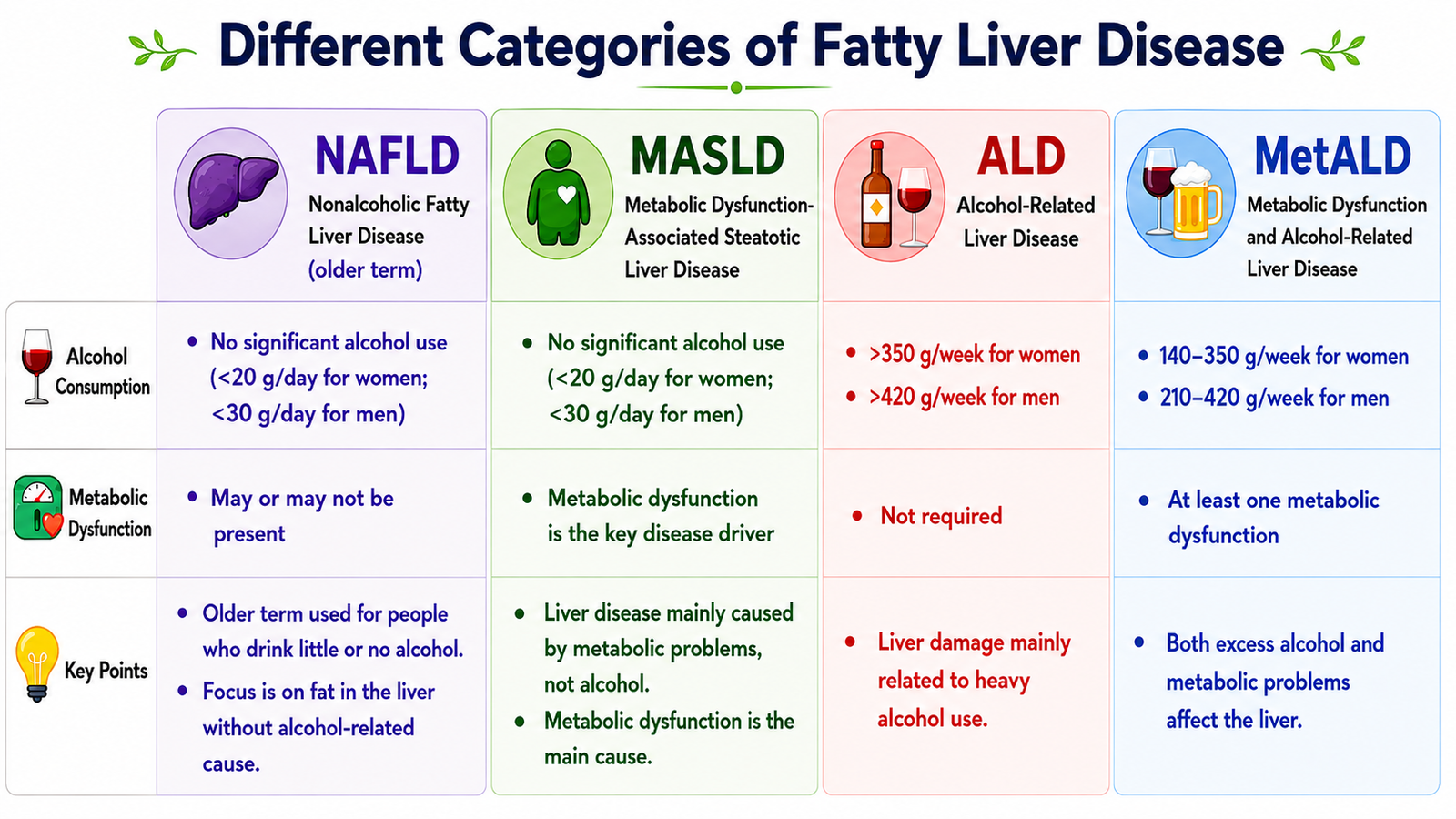
Non-Alcoholic Fatty Liver Disease (NAFLD)
- NAFLD is the older term used for people who drink little or no alcohol.
- It is diagnosed when more than 5% fat is present in the liver.
- Alcohol intake is not excessive (less than 20 g/day for women and 30 g/day for men).
- Other causes of liver disease, such as hepatitis, have been ruled out.
Metabolic Dysfunction–Associated Fatty Liver Disease (MAFLD)
- MAFLD is the newer term introduced in 2020 for fatty liver disease associated with metabolic health problems.
- It occurs when excess fat builds up in the liver (more than 5%) in people with conditions such as:
- Overweight or obesity
- Type 2 diabetes
- High blood pressure
- High cholesterol or triglycerides
- Metabolic syndrome
Metabolic Dysfunction-Associated Steatotic Liver Disease (MASLD)
- This is the current name for fatty liver disease, introduced in 2023 to replace the earlier term MAFLD.
- MASLD refers to fat buildup in the liver (more than 5%) in people with at least one cardiometabolic risk factor, such as obesity, type 2 diabetes, or high blood pressure, without harmful alcohol consumption.
Alcohol-Related Fatty Liver Disease (ALD)
- ALD develops when excess alcohol consumption causes fat to accumulate in the liver.
- If alcohol use continues, it can progress to liver inflammation, scarring, and cirrhosis.
Metabolic Dysfunction and Alcohol-Related Liver Disease (MetALD)
- is a new term for people with MASLD who also consume moderate amounts of alcohol, meaning both metabolic problems and alcohol contribute to liver fat and liver damage.
How Does Fatty Liver Disease Progress?
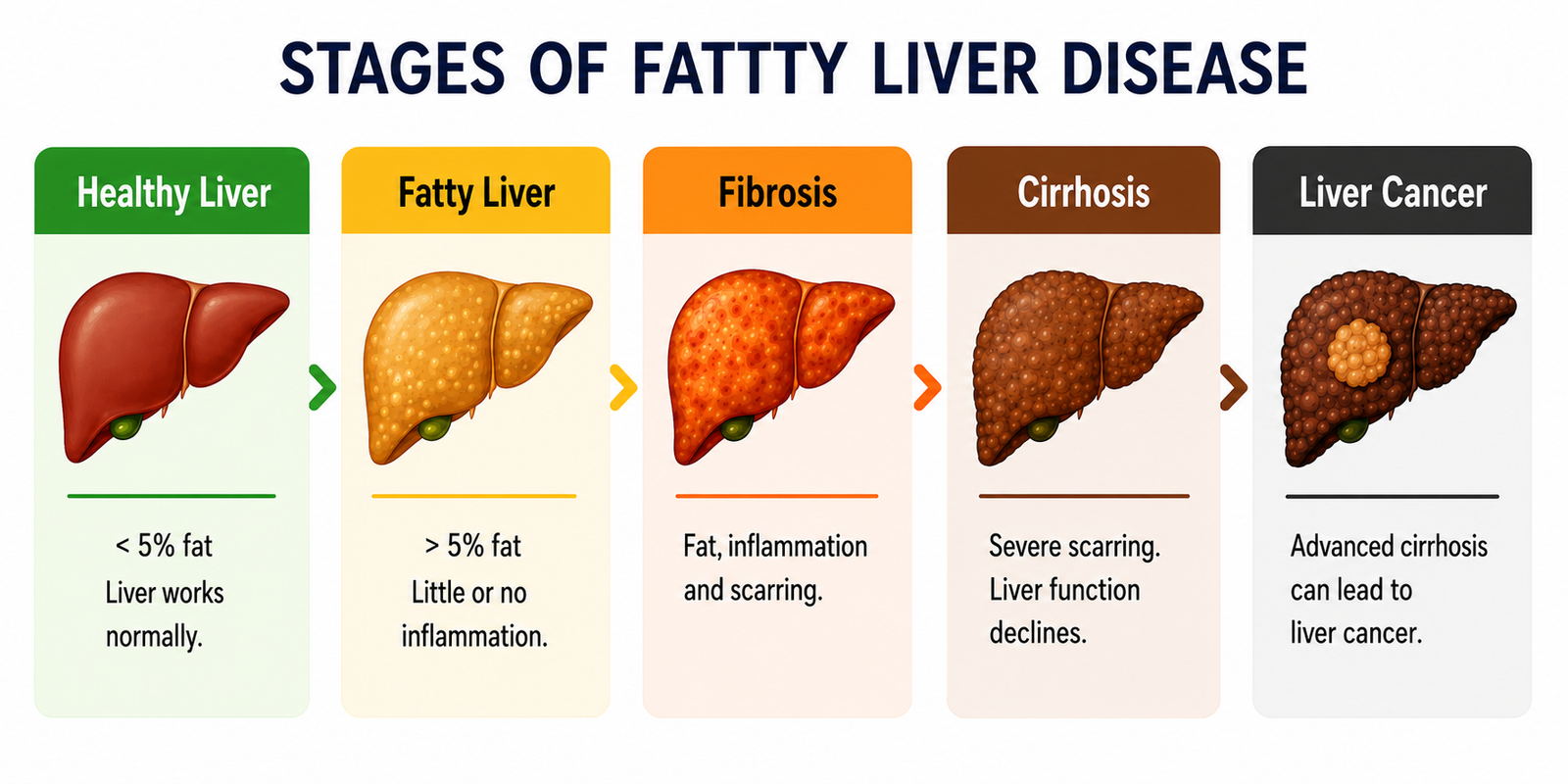
🟢 Healthy Liver
- Less than 5% fat is present in the liver.
- The liver works normally and stays healthy.
🟡 Fatty Liver
- More than 5% fat builds up in the liver.
- There is little or no inflammation or liver damage.
- This stage can often be reversed with a healthy diet, exercise, and weight loss.
🟠 Fibrosis
- The liver has excess fat, inflammation, and early scarring (fibrosis).
- If left untreated, liver damage can worsen over time.
🟤 Cirrhosis
- Severe scarring has developed in the liver.
- In the early stage, the liver may still work fairly well, and symptoms may be absent.
- As cirrhosis progresses, the liver loses its ability to function properly.
- Serious complications such as fluid buildup, jaundice, bleeding, or confusion can occur.
⚫Liver Cancer
- Some people with advanced cirrhosis may develop liver cancer, called hepatocellular carcinoma (HCC).
- Regular check-ups help detect liver cancer early in people at risk.
What are the Symptoms of Fatty Liver disease?
In the early stages, fatty liver disease usually causes no symptoms. It is often discovered during a routine health check-up or an imaging test done for another reason.
As the disease progresses, symptoms may include:
- 😴 Fatigue or tiredness
- 🤕 Pain or discomfort in the upper right side of the abdomen
- 💛 Yellowing of the skin and eyes (jaundice)
- 🤢 Nausea or vomiting
- 🍽️ Loss of appetite
- ⚖️ Unintentional weight loss
- 🌡️ Fever (in some cases)
Symptoms of Advanced Liver Disease (Cirrhosis)
If fatty liver disease progresses to cirrhosis, symptoms may include:
- 💧 Swelling of the abdomen (ascites)
- 🦵 Swelling of the legs and ankles
- 🕸️ Spider-like blood vessels on the skin (spider angiomas)
- 🩸 Easy bruising or bleeding
- 🖐️ Itchy skin
- 🧠 Confusion, memory problems, or difficulty concentrating
⚠️ Did You Know? Heart disease is the leading cause of death among people with fatty liver disease. Since fatty liver often has no symptoms, regular check-ups are important!!
How Is Fatty Liver Disease Diagnosed?
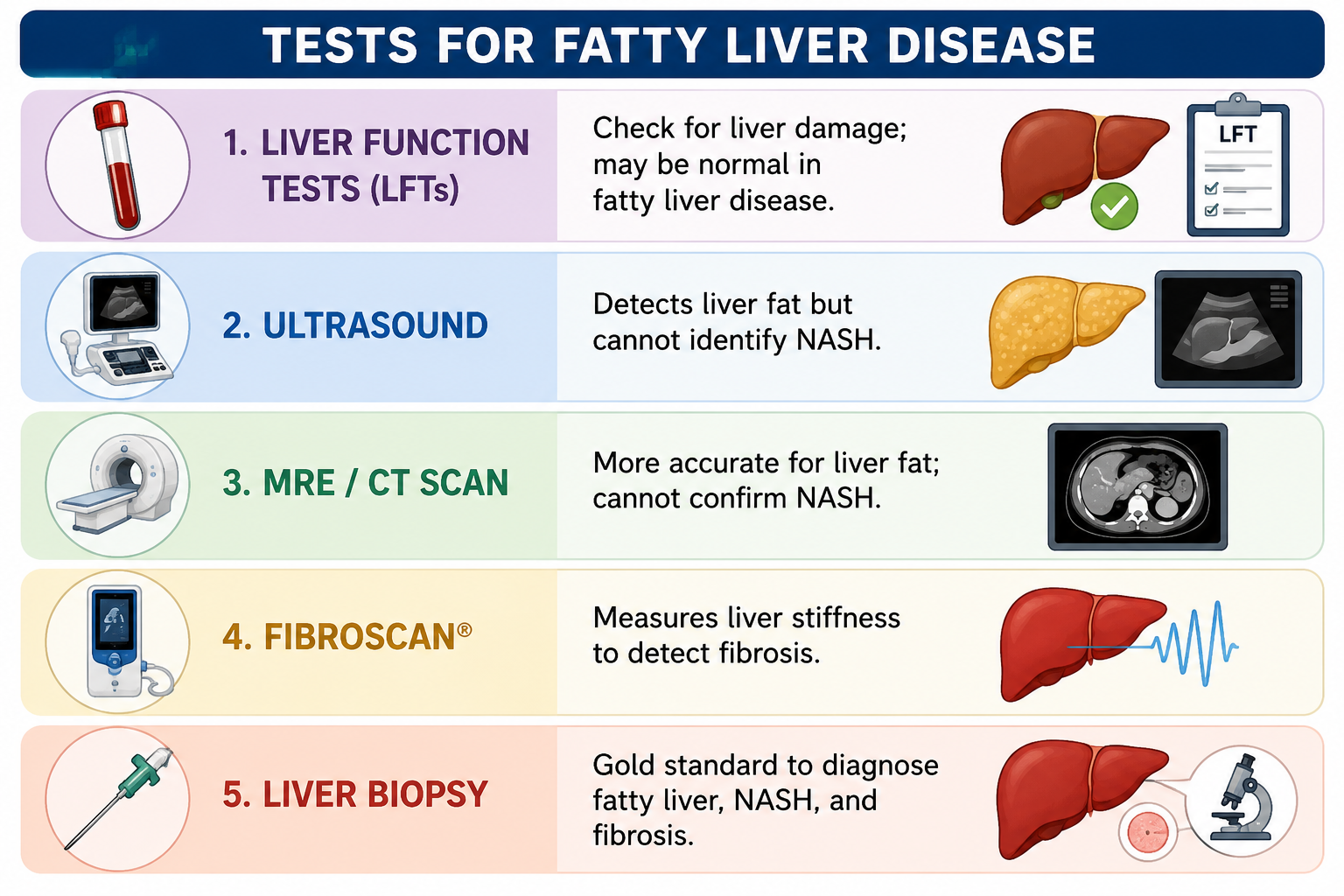
- Liver function tests: Check for liver damage. However, some people with the disease may have normal tests.
- Ultrasound: The most common test for detecting liver fat. It cannot differentiate between simple fatty liver and fibrosis.
- MRI or CT Scan: More accurate than ultrasound for detecting liver fat, but more expensive and still cannot reliably distinguish fibrosis from simple fatty liver.
- Transient Elastography (FibroScan®): A painless scan that measures liver stiffness to detect liver scarring (fibrosis).
- Liver Biopsy: A small sample of liver tissue is examined under a microscope. It is the gold standard for diagnosing the disease, inflammation, and fibrosis. Because it is invasive, it is recommended only in select cases.
How is Fatty Liver Disease Treated?
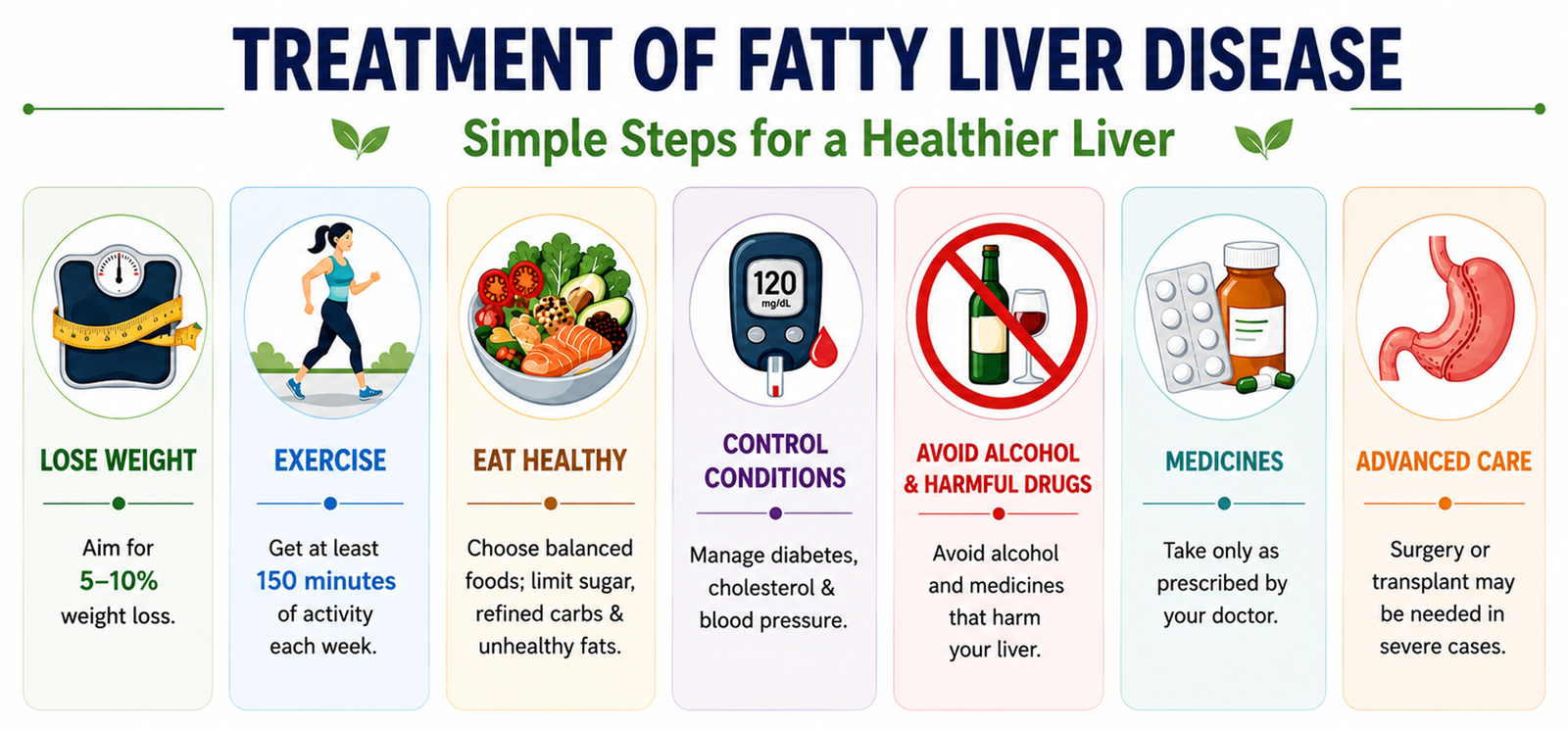
There is no single medicine that can cure this disease. The most effective treatment is making healthy lifestyle changes.
- Weight loss: Even losing 3–5% of your body weight can reduce liver fat. Losing 7–10% may also help reduce liver inflammation and damage.
- Exercise regularly: Aim for at least 150 minutes of moderate physical activity each week.
- Eat a healthy, balanced diet: Limit sugary foods, refined carbohydrates, and unhealthy fats.
- Control diabetes, high cholesterol, and high blood pressure if you have them.
- Avoid alcohol, as it can worsen liver damage.
- Take medicines only as advised by your doctor: While some medicines may help certain patients, they are not suitable for everyone and are recommended only in specific situations.
- Weight-loss surgery may be an option for people with severe obesity if lifestyle changes alone are not enough.
- In advanced liver disease or cirrhosis, a liver transplant may be needed in rare cases.
Frequently Asked Questions
Can fatty liver disease be reversed?
Yes. In its early stages, fatty liver disease can often be reversed through lifestyle changes such as losing excess weight, eating a healthy diet, exercising regularly, and effectively managing conditions like diabetes and high cholesterol.
Can thin people develop fatty liver disease?
Being slim doesn’t always mean a healthy liver. Genetics, hidden visceral fat, sugary and refined foods, Physical inactivity, stress, and poor sleep can promote fatty liver even without weight gain.
Is fatty liver disease dangerous?
It can be. While early fatty liver disease may not cause symptoms, untreated disease can progress to liver inflammation, fibrosis (scarring), cirrhosis, liver failure, or even liver cancer.
Does fatty liver disease run in families?
Yes. Genetics can play a role. If a close family member has fatty liver disease, your risk may be higher, even if you do not have obesity or diabetes.
When should I see a doctor?
Consult a healthcare professional if you have persistently abnormal liver function tests, risk factors such as obesity or diabetes, or imaging findings that suggest fatty liver disease. Early diagnosis and treatment can help prevent complications.
Key Takeaways
✅ Fatty liver disease often causes no symptoms.
✅ It is closely linked to obesity and diabetes.
✅ Early stages can often be reversed.
✅ Weight loss and exercise are the best treatments.
✅ Regular check-ups help prevent complications.
Further Reading
- Younossi, Z. M., Golabi, P., Paik, J. M., Henry, A., Van Dongen, C., & Henry, L. (2023). The global epidemiology of nonalcoholic fatty liver disease (NAFLD) and nonalcoholic steatohepatitis (NASH): A systematic review. Hepatology, 77(4), 1335–1347. https://doi.org/10.1097/HEP.0000000000000004
- Habibullah, M., Jemmieh, K., Ouda, A., Haider, M. Z., Malki, M. I., & Elzouki, A.-N. (2024). Metabolic-associated fatty liver disease: A selective review of pathogenesis, diagnostic approaches, and therapeutic strategies. Frontiers in Medicine, 11, Article 1291501. https://doi.org/10.3389/fmed.2024.1291501
- Rinella, M. E., Lazarus, J. V., Ratziu, V., Francque, S. M., Sanyal, A. J., Kanwal, F., Romero, D., Abdelmalek, M. F., Anstee, Q. M., Arab, J. P., Arrese, M., Ayonrinde, O. T., Bataller, R., Bellentani, S., Berzigotti, A., Bugianesi, E., Chalasani, N. P., Cortez-Pinto, H., Cusi, K., … George, J. (2024). A multisociety Delphi consensus statement on new fatty liver disease nomenclature. Annals of Hepatology, 29, 101133. https://doi.org/10.1016/j.aohep.2023.101133
- Gómez-Mendoza, R., Sánchez-Hernández, F., Valentin-Cortez, F. J., & Chávez-Tapia, N. (2025). Fatty liver disease in the pediatric population: History, definitions, and challenges in nomenclature (NAFLD/MAFLD/MASLD). Metabolism and Target Organ Damage, 5, 24. https://doi.org/10.20517/mtod.2024.108
- Gao, B., Arab, J. P., Liangpunsakul, S., Ding, W.-X., Szabo, G., Mehal, W., Wang, H., He, Y., Stärkel, P., Llorente, C., Schnabl, B., Hwang, S., Vandermerwe, S., Gao, Y., Zheng, M.-H., Kim, W., George, J., Bataller, R., Loomba, R., Leggio, L., & Tacke, F. (2025). Metabolic dysfunction and alcohol-associated liver disease (MetALD). eGastroenterology, 3(4), e100319. https://doi.org/10.1136/egastro-2025-100319
- Friedman, S. L., Neuschwander-Tetri, B. A., Rinella, M., & Sanyal, A. J. (2018). Mechanisms of NAFLD development and therapeutic strategies. Nature Medicine, 24(7), 908–922. https://doi.org/10.1038/s41591-018-0104-9.
- Umbro, I., Baratta, F., Angelico, F., & Del Ben, M. (2021). Nonalcoholic fatty liver disease and the kidney: A review. Biomedicines, 9(10), 1370. https://doi.org/10.3390/biomedicines9101370
- Nagarjuna, D., & Karthikeyan, E. (2025). Alcohol-associated liver disease: A review. Gastroenterology & Endoscopy, 3(2), 65–85. https://doi.org/10.1016/j.gande.2025.01.003.
- Antunes, C., Azadfard, M., Hoilat, G. J., & Gupta, M. (2023). Fatty liver. In StatPearls. StatPearls Publishing. https://www.ncbi.nlm.nih.gov/books/NBK441992/
- Friedman, S. L., Neuschwander-Tetri, B. A., Rinella, M., & Sanyal, A. J. (2018). Mechanisms of NAFLD development and therapeutic strategies. Nature Medicine, 24(7), 908–922. https://doi.org/10.1038/s41591-018-0104-9
Disclaimer: The information provided on Medical Pharma Lifestyle Pulse is for educational and informational purposes only and is not intended as medical advice, diagnosis, or treatment. Always consult a qualified healthcare professional before making any decisions about your health, medications, or treatment. Never ignore or delay seeking professional medical advice based on information you have read on this website. While we strive to provide accurate and up-to-date information, we do not guarantee the completeness or accuracy of the content. For more information, please read our full Medical Disclaimer.