
Table of Contents
Introduction
The American Heart Association (AHA) and American College of Cardiology (ACC) have released the 2026 dyslipidemia guidelines, introducing important updates in lipid management. These include a novel risk prediction model, more stringent lipid targets, and a stronger emphasis on early and personalized intervention.
Let’s break down the key takeaways in a simple, practical way.
Key Recommendations
Screen Early
- Screening can begin as early as age 2 years in children with:
- Family history of premature ASCVD
- Severe hypercholesterolemia
- Familial hypercholesterolemia (FH)
- Universal screening is recommended at: 9–11 years
Check REGULARLY
- Screen again at the age of 19 years
- Recheck every 5 years and use prevent ASCVD to assess risk
New Risk Calculator: PREVENT™
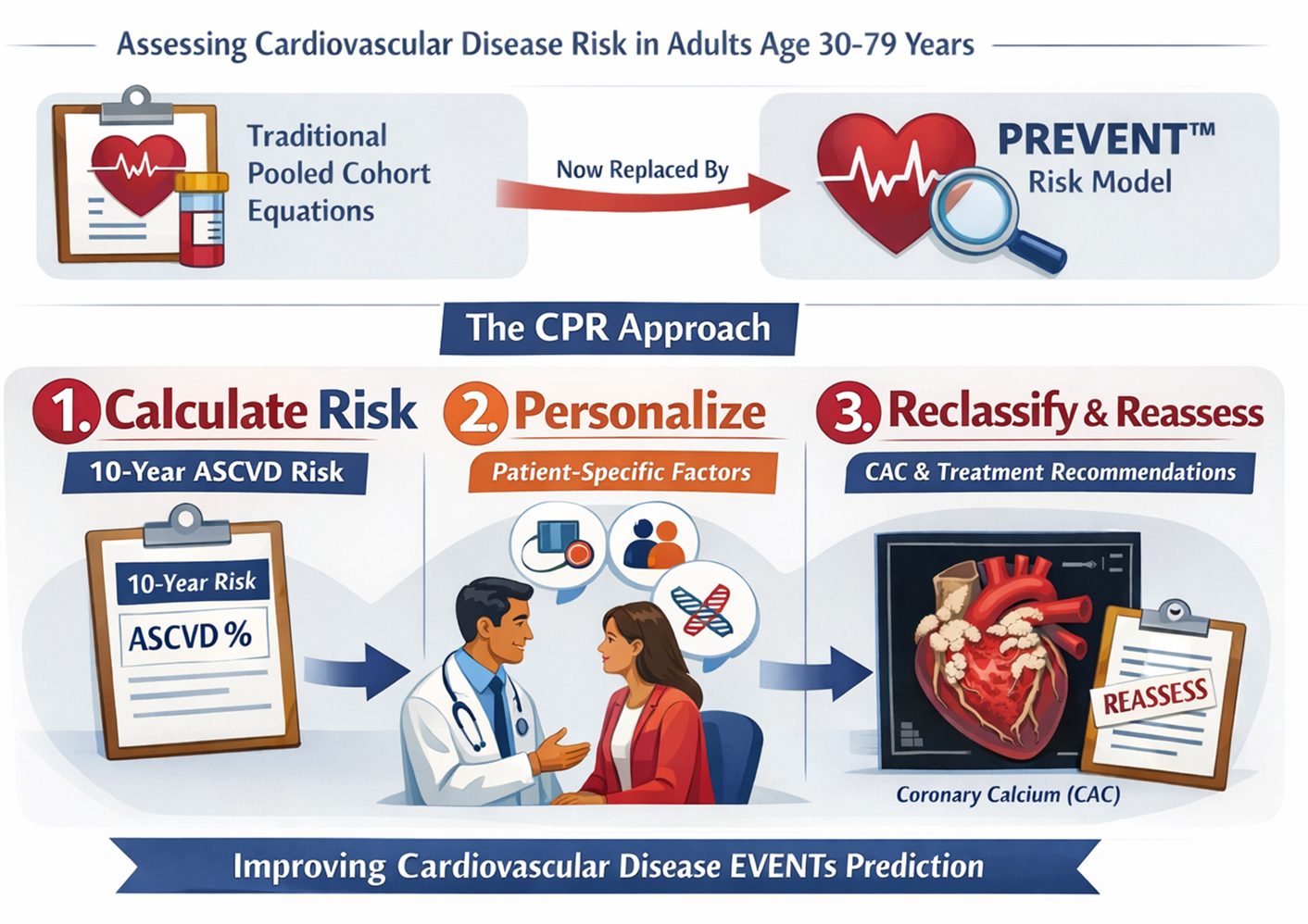
The traditional pooled cohort equations for 10- and 30-year risk assessment to guide lipid-lowering therapy in primary prevention in adults aged 30 to 79 years are now being replaced by the Predicting Risk of cardiovascular disease EVENTs (PREVENT™) risk model.
It follows a CPR approach:
- Calculate risk (10-year ASCVD risk)
- Personalize based on patient-specific factors
- Reclassify using tools like coronary artery calcium (CAC) and reassess treatment recommendations.
Act Early to Reduce Lifetime Risk
- Early identification ↓ prolonged exposure to atherogenic lipoproteins
- Lowers cumulative ASCVD risk over time
Lipoprotein(a) [Lp(a)]: Measure at least once
- Measure lipoprotein A [Lp(a)] at least once in a lifetime to identify those individuals at higher risk of ASCVD
- High-risk thresholds:
- ≥50 mg/dL → 1.4-fold increased ASCVD risk
- ≥100 mg/dL → ≥2-fold higher estimated ASCVD risk
👉Elevated Lp(a) indicates the need for intensified LDL-C lowering and managing other risk factors.
Apolipoprotein B (ApoB): The “Better Marker” in Some Cases
- ApoB testing can improve risk assessment and guide therapy after LDL-C and non–HDL-C goals are met, especially in those with
- High triglycerides (>200 mg/dL)
- Diabetes
- Low LDL-C but persistent risk
👉 ApoB measurement helps identify adults with residual lipid-related risk that standard lipid profiles may underestimate and aids in diagnosing specific lipid and lipoprotein disorders.
Coronary Artery Calcium (CAC): A Tool for Risk Refinement
- CAC scoring in men aged 40 and women 45+ improves risk assessment and guides LDL-C and non–HDL-C goals.
- Both CAC amount and standardized percentile (based on age, sex, and race) are prognostic and aid in reclassifying adult risk.
Treatment goals
- LDL-C and non–HDL-C goals resume guiding lipid-lowering therapy.
- Reducing LDL-C percentage remains a priority, with goals depending on ASCVD risk level.
- Consider early pharmacotherapy in Young Adults with
- Familial hypercholesterolemia
- LDL-C ≥160 mg/dL
- Strong family history of ASCVD
- Treat LONGER (Older Adulthood)
LDL-C Targets
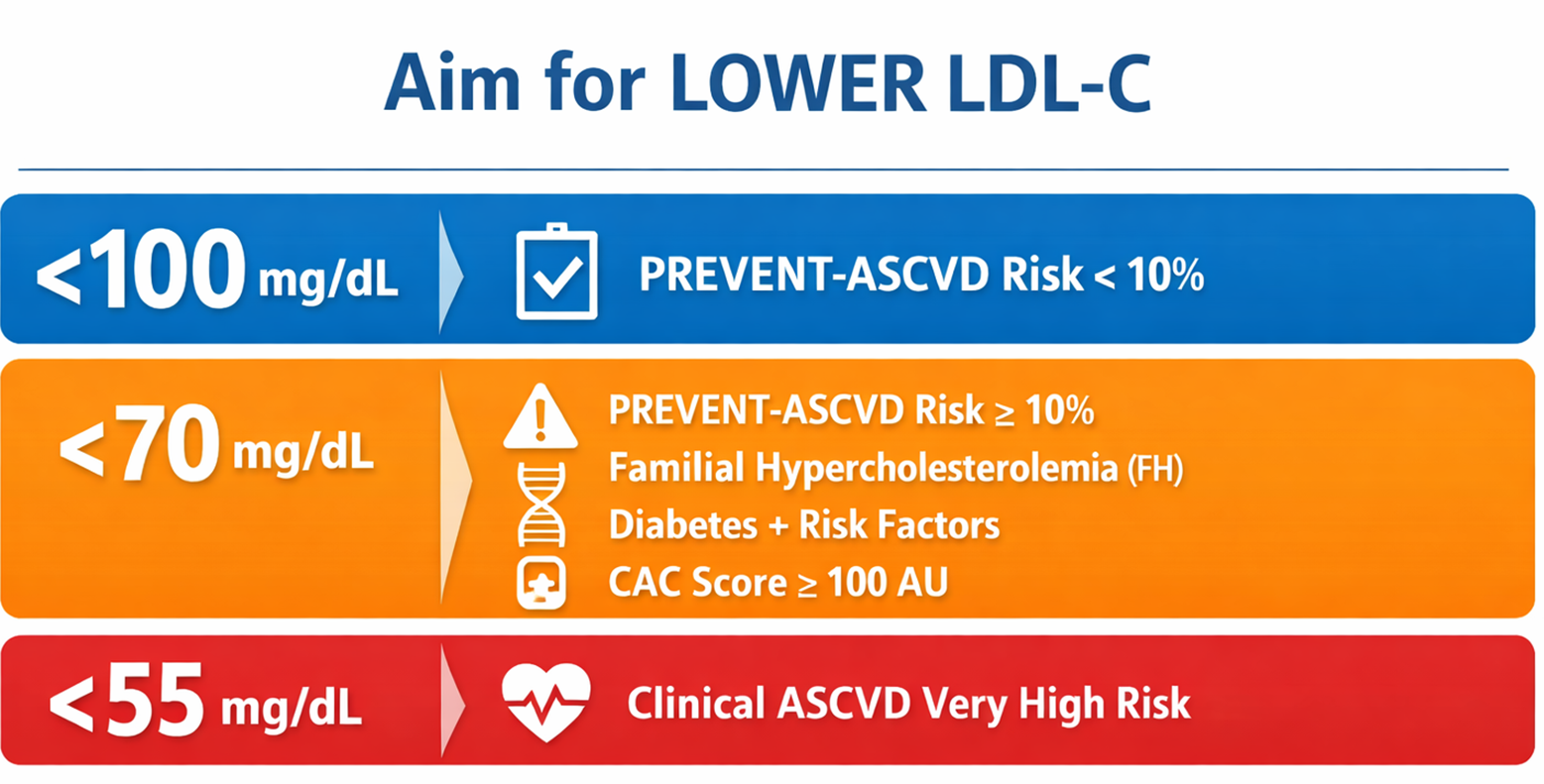
- <100 mg/dL
- Recommended for individuals with PREVENT-ASCVD risk <10%
- <70 mg/dL
- Recommended for individuals with: PREVENT-ASCVD risk ≥10%
- Familial hypercholesterolemia (FH)
- Diabetes mellitus with additional risk factors
- Coronary artery calcium (CAC) score ≥100 Agatston units
- Recommended for individuals with: PREVENT-ASCVD risk ≥10%
- <55 mg/dL
- Recommended for individuals with clinical ASCVD at a very high-risk
Start Lifestyle Measures Early
- Initiate health behavior counseling in youth
- Focus on:
- Heart-healthy diet
- Regular physical activity
- Weight optimization
Treat longer (Older Adulthood)
- Monitoring: Check lipids 4–12 weeks after starting or changing the dose of lipid-lowering therapy, then every 6–12 months thereafter.
- Duration: Benefits increase with longer therapy; tailor duration to individual risk.
LDL-Lowering Therapy: for Primary Prevention
- in adults without ASCVD with a 10-year PREVENT-ASCVD risk of:
- 3% to <5% (borderline risk)
- 5% to <10% (intermediate risk)
- regardless of baseline LDL-C levels for primary prevention in adults aged 40 to 75 years with:
- Diabetes
- Chronic kidney disease (stage 3 or 4)
- Human immunodeficiency virus (HIV)
- In adults aged >75 years, LDL-C–lowering pharmacotherapy may be considered alongside lifestyle interventions to reduce ASCVD risk.
Triglycerides Management
- Statins remain first-line therapy alongside lifestyle interventions in patients with persistently elevated triglycerides (TG) to reduce ASCVD risk
- severe hypertriglyceridemia: TG ≥1000 mg/dL
- Initiate TG-lowering therapies (omega-3 fatty acids, fibrates, and others)
- Primary goal → prevent acute pancreatitis
Conclusion
The 2026 dyslipidemia guidelines mark a shift toward earlier detection, personalized risk assessment, and more aggressive lipid lowering. By integrating tools like the PREVENT model and Lp(a) measurement, clinicians can better identify high-risk individuals. Ultimately, the goal is simple: reduce lifetime ASCVD risk through timely and targeted intervention.
Further Reading
- Wiggins BS, Barac A, Benziger CP, Blumenthal RS, Cibotti-Sun M, Moore M, et al. 2026 dyslipidemia guideline-at-a-glance. Journal of the American College of Cardiology. Published online 2026.https://www.jacc.org/doi/10.1016/j.jacc.2026.02.4872
- Blumenthal RS, Morris PB, Gaudino M, Johnson HM, Anderson TS, Bittner VA, et al. 2026 ACC/AHA/AACVPR/ABC/ACPM/ADA/AGS/APhA/ASPC/NLA/PCNA guideline on the management of dyslipidemia: a report of the American College of Cardiology/American Heart Association Joint Committee on Clinical Practice Guidelines. Circulation.https://www.ahajournals.org/doi/10.1161/CIR.0000000000001423
Disclaimer: The information provided on Medical Pharma Lifestyle Pulse is for educational and informational purposes only and is not intended as medical advice, diagnosis, or treatment. Always consult a qualified healthcare professional before making any decisions about your health, medications, or treatment. Never ignore or delay seeking professional medical advice based on information you have read on this website. While we strive to provide accurate and up-to-date information, we do not guarantee the completeness or accuracy of the content. For more information, please read our full Medical Disclaimer.